

Dealer Management System
One record per vehicle for a dealership: photos, papers, maintenance cost, both sides of the money and the sale itself.
A dealership buys a vehicle, spends money on it, parks it somewhere, shows it to buyers and sells it — and each of those steps usually lives in a different notebook. This system keeps them on one record: where the vehicle is, what it cost, what has been spent on it, which papers belong to it, who is interested in buying it, and what is still owed on either side.
- Project
- Dealer Management System
- Type
- Dealership workspace
- Built for
- Independent and multi-brand dealerships
- Covers
- Cars, buses, trucks and three-wheelers
- Line of work
- 01Web Design & Development 03ERP & Business Systems
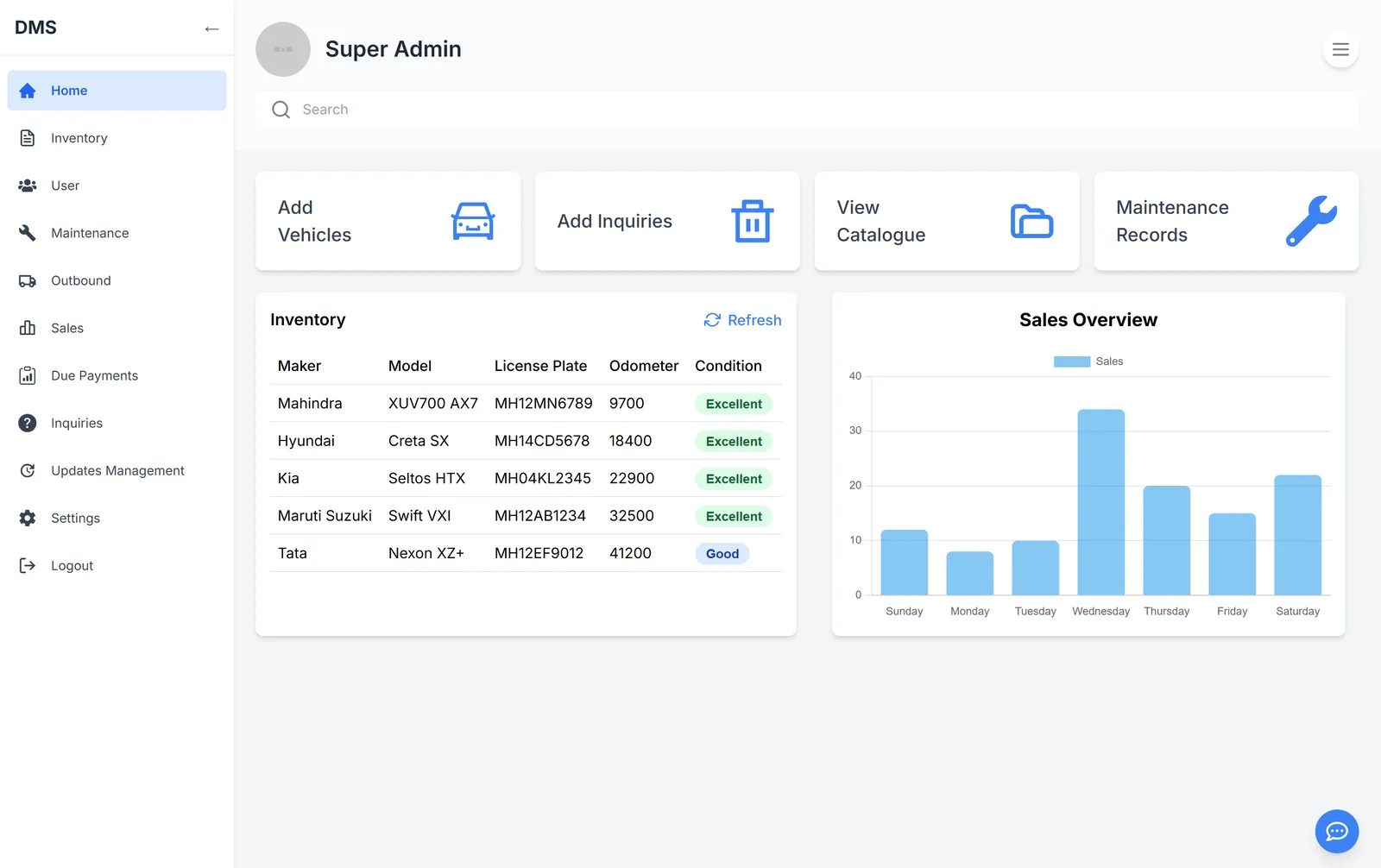
Dealer Management System in use.
The yard, on one screen
Every vehicle on the yard has a record — make, model, year, registration, mileage, fuel type, transmission, condition, colour and the parking slot it is standing in. Inventory reads as a photo-led grid or a compact table, and narrows by mileage, fuel, transmission, price, condition or slot.
That is the question a salesperson gets asked all day: what do we have, what condition is it in, and what does it cost. Here it is answered at the counter, without walking out to check a slot number.
- Search by make, model or plate
- Filter by condition, fuel, mileage, price or parking slot
- One record per vehicle, not one per department
Intake that finishes on day one
A guided three-step process captures the vehicle, the seller, the inspection findings, photos, ownership papers, the purchase agreement and the payment schedule at the point of purchase rather than weeks later.
Everything then hangs off the same vehicle: service type, date, cost, who did the work and the receipt, with filters and a spreadsheet export for accounts.
- Ownership proof, purchase agreement, buyer identity document and maintenance receipts in one document view
- Customer and broker inquiries in one list, with the vehicle the buyer wants, their budget and preferred model
A price that survives the discount
The true cost of a vehicle is the purchase price plus every recorded maintenance spend. The dealer sets a percentage margin or a fixed profit, and the selling price follows from that number rather than from a guess.
Quoting from true cost is what stops a price that looks healthy on the board and quietly loses money when the vehicle finally leaves the yard.
The money, on both sides
For each vehicle, what is still payable to the seller and what is still receivable from the buyer sit next to the resulting profit or loss. Payment records capture the amount, date, method and remark.
Once a vehicle is outbound it leaves available stock and the sales figures follow, so nobody quotes a vehicle that has already gone. The sales view carries vehicles in stock, vehicles sold, total sales value, the last twelve months, and the split between purchase cost, other expenses and profit.
- Both sides of the money in one view, next to the profit or loss
- A yard you can actually see, searchable by make, model or plate
- Present a clean, customer-ready catalogue without assembling a brochure by hand