

Nucleust E-paper
A printed edition that reads properly on a phone: the page stays the page, and every story on it opens into readable text.
Print readers are moving to small screens, but most digital editions make them choose between a page-turner that is miserable on a phone and an article list that throws the front page away. This keeps both. The printed page stays the primary object and every story on it is a door into readable text, so layout readers stay in the page and story readers switch to a clean reading view without leaving the edition.
- Project
- Nucleust E-paper
- Type
- In-house digital edition platform
- Built for
- Publishers and newsrooms
- Archive
- Three public-domain front pages from 1968 and 1977
- Line of work
- 01Web Design & Development
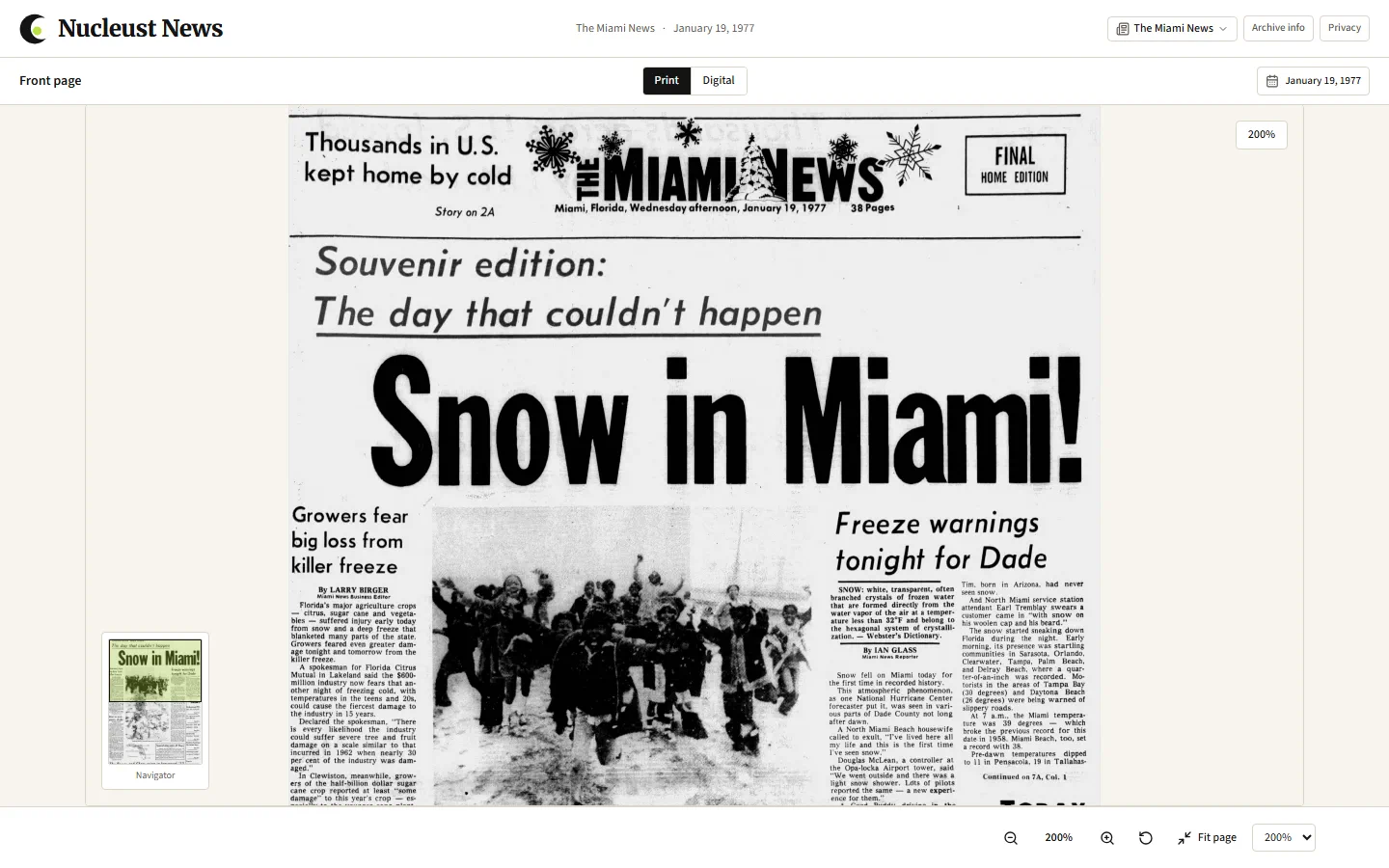
Nucleust E-paper in use.
The page stays the page
The front page opens at a comfortable size, zooms smoothly to inspect a headline or a photograph, and fits to the screen or to the page width. A small page map shows where the reader is, and on a phone the same page responds to pinching, dragging and double-tapping.
Tapping a story region opens it over the page, so the reader never loses their position: headline, standfirst, byline, reading time, page and section, plus the original clipping for anyone who wants to see how it printed.
For the reader who wants text
The Digital view lists the edition's stories grouped by section — Front Page, Business, Weather, News — with reading times and page references. It keeps the edition's structure instead of flattening everything into a feed.
The same edition, the same stories and the same page positions are available on desktop and mobile. Nothing needs to be installed and there is no separate app to keep updated.
Publishing without a developer
An editor uploads the print-ready PDF for an issue. The platform prepares the page images and thumbnails, reads the page to suggest where the stories sit, and produces a first pass of clickable regions.
In the workspace the editor confirms, rejects, redraws, moves or resizes every suggested region, and each one is marked auto-detected, verified or rejected so the state of an issue is obvious. Reprocessing after a correction keeps the regions already verified or rejected, and preserves the previous version rather than overwriting it.
New issues start unpublished, and publish, unpublish, delete or reprocess each take effect in the public archive immediately. Each publication keeps its own identity, location, language, logo and address, and a credits page names every source with its date, rights status and a link back to the original file.
Why it holds together
The edition opens at a comfortable size, keeps its page map, and treats every story as a door into readable text — and the public edition is a self-contained package that keeps serving readers even when the workspace is unavailable.
- Both kinds of reader served at once: layout readers stay in the page, story readers switch to clean text
- Editors publish without a developer and without hand-placing a region
- One archive, many titles, each with its own public address
- Advertising designed in, with consent handled before anything loads