

Future Sales
One workspace for a business that makes, moves and sells physical products — sales, stock, production, counter, staff, support and books.
Growing businesses do not struggle for effort; they struggle because there is no single version of the truth. Orders sit in a notebook, stock in a spreadsheet, invoices in a billing tool, and the real numbers arrive from the accountant weeks after the month has closed. Here a quotation, an order, a delivery, an invoice, a payment and a production run are each recorded once, in one place, and the stock position and the books move together.
- Project
- Future Sales
- Type
- Business management system
- Built for
- Manufacturers, workshops, wholesalers, distributors and retailers with shop counters
- Runs on
- One Windows computer
- Line of work
- 03ERP & Business Systems
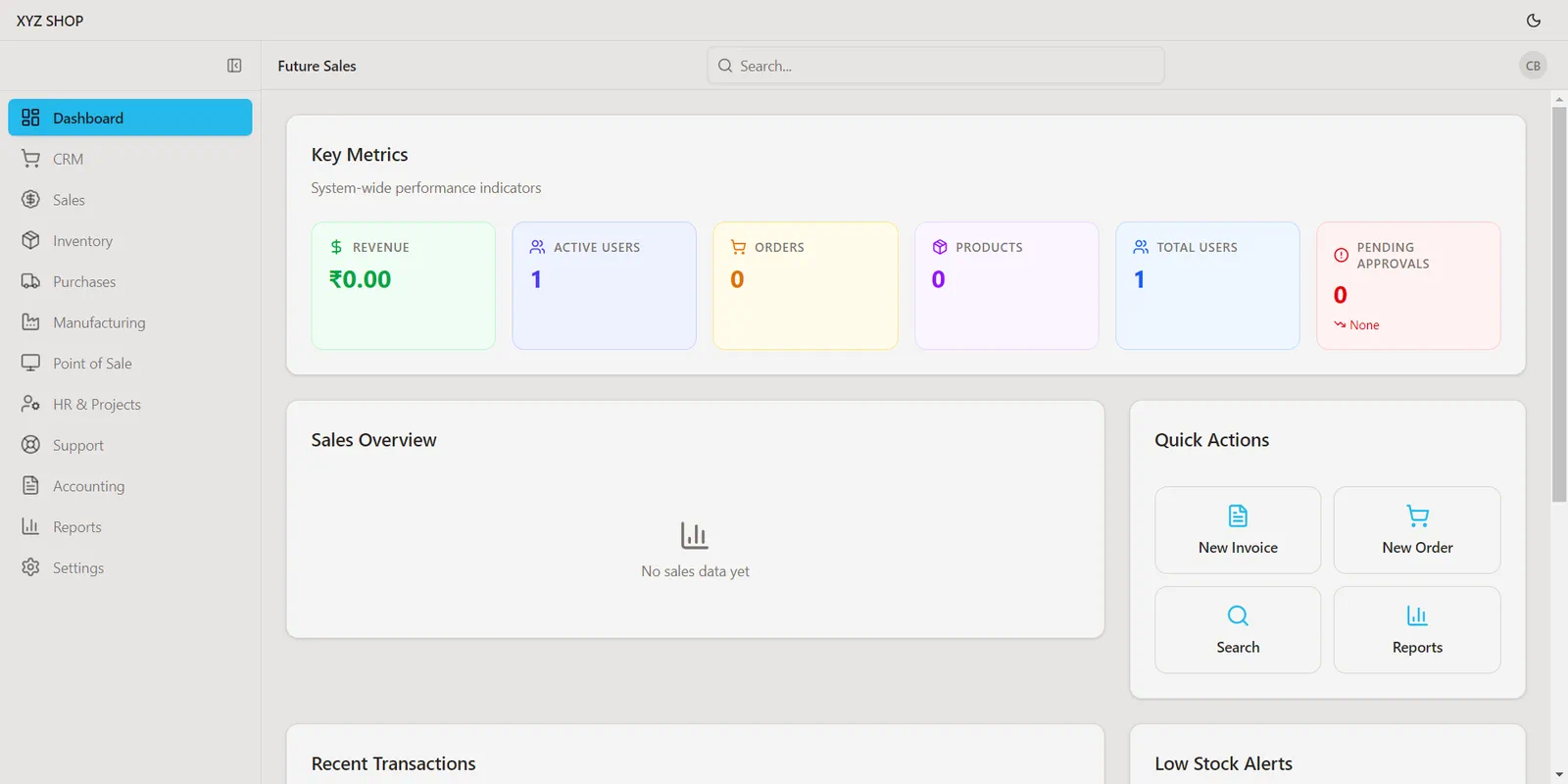
Future Sales in use.
Follow a sale from first enquiry to money in the bank
A lead becomes a customer, a customer becomes an opportunity, an opportunity becomes a quotation, the quotation becomes an order, the order becomes an invoice, and the invoice is cleared by a payment. The same line items travel with the deal, so nobody retypes a price or forgets a discount.
At any point the owner can see what has been quoted, what has been ordered, what has been billed and what is still owed. The opening screen shows revenue, orders, products, active users, anything waiting for approval, recent transactions, a sales trend and a low-stock list.
Stock, purchasing and production on the same record
Items, multiple storage locations and batch tracking give a live quantity for every product and raw material. Stock rises when goods are received and falls when they are sold, consumed in production or sold at the counter, with low-stock warnings before anything runs out and a valuation view of what is on hand.
Purchase orders are raised, approved and received; receiving goods increases stock and records what is owed to the supplier in the same step. A product's recipe defines the materials and quantities in one unit, and work orders are tracked from draft to completion with material issue and finished goods.
Work centres, routings and capacity planning show where the time goes, and the cost of the materials follows the product into stock and into the margins.
The counter and the books
A touch-friendly point of sale lets staff tap products into a basket, split payment across cash, card or transfer, take payment, print a receipt and close the day against counted cash. If the connection drops, sales queue and complete later.
Every invoice, payment, goods receipt and payroll run writes its own accounting entry, so the trial balance, profit and loss, balance sheet and cash flow are current rather than reconstructed. Manual double-entry journals, bank reconciliation and drilling into any account are still there when they are needed.
Tax can be switched on or off. On, invoices split tax correctly within the state and across state lines, use the rates the business defines, and can treat prices as tax-inclusive. Twenty-two ready reports take a date range and export to a spreadsheet.
Why one record matters
A quotation, a stock movement and an accounting entry are the same event seen from different angles, so the numbers cannot disagree with each other.
- Built for businesses that make and move physical products: recipes, work orders, material issue, batch tracking and counter sales are part of the product
- Trading does not stop when the connection does
- The books post themselves instead of being reconstructed at month end
- It grows without a migration: billing and stock first, then purchasing, production, a counter, payroll and a full ledger