

Marble Export ERP
An operations platform for granite and marble trading that is built around the block, not around a product list.
Stone is not a normal inventory business. Every block is different: different dimensions, grade, veining, cost, and often a different country of origin. A trader may buy in euros, sell in dirhams, move material in containers, and serve both straightforward trading customers and factory customers who need cutting and finishing. This keeps the whole operation visible in one place, from the container arriving to the final invoice.
- Project
- Marble Export ERP
- Type
- Operations platform for stone
- Built for
- Importers, trading houses, fabrication units and project suppliers
- Currencies
- AED, USD and EUR
- Line of work
- 03ERP & Business Systems
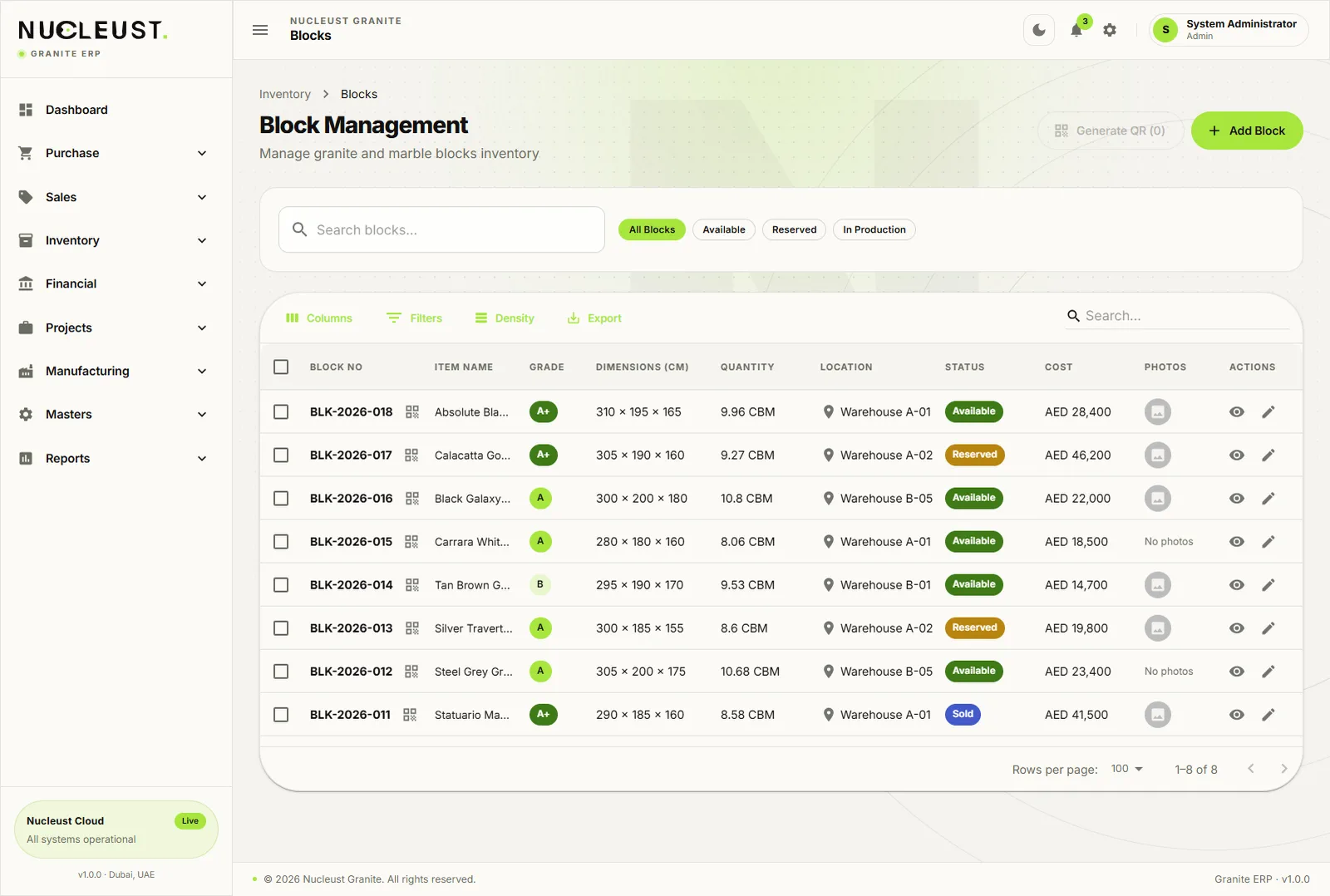
Marble Export ERP in use.
Every block is a record
Each block has its own number, material, grade, dimensions, quantity, photographs, supplier, warehouse location, cost and availability status. The register is searchable and filterable, so it matches the yard instead of a yard marshal's memory or an old stock sheet.
Receiving a consignment creates the block records for it, so the stock register reflects the real container rather than an approximate total.
Landed cost, not invoice cost
The system separates what the supplier billed from what the block actually cost after freight and clearing expenses. That makes it clear what a block really costs before it is priced for sale, and it exposes margin erosion that a purchase-price view hides.
Shipping line, vessel, voyage, loading and discharge ports, departure and arrival dates and clearance status are recorded against each container, together with the blocks and receiving documents that came out of it. When a customer asks where their material is, the answer is not buried in an email chain.
One paper trail, three currencies
Quotations are prepared, approved, rejected and converted into sales orders. Loading advice supports both trading and factory flows, and delivery notes and print-ready VAT sales invoices follow the same record.
Purchases and sales can be recorded in AED, USD or EUR, with exchange rates and converted values kept alongside the original amounts, so the buying currency, the selling currency and the reporting currency never have to be forced into one.
Payment and receipt vouchers, customer and supplier balances and post-dated cheques sit beside the orders and invoices the team works on every day.
Why the block is the right foundation
Many systems can hold a product list. Far fewer can hold a stone block with its own dimensions, grade, photographs, supplier, container, landed cost and current status while also supporting trading and factory sales in several currencies.
- Stock value based on real blocks, not estimates
- A receiving document traceable back to the container and supplier behind it
- A block's cost compared with its intended selling price before it is committed
- Roles and permissions that decide who can create, approve, edit or only view