

Naap
A tailoring till that keeps the measurement, the delivery date and the balance on the phone the shop already owns.
Tailoring runs on measurements and dates, and both are usually written on paper. A measurement book fills up or goes missing; a slip tied to a bundle tells the workshop what to stitch but not the shop what was promised; balances get worked out on the back of a bill. This moves all of it into the phone the shop already owns, so a measurement is entered once and reused, a delivery date is a calendar entry, and a balance is arithmetic.
- Project
- Naap
- Type
- Point of sale for tailoring shops
- Built for
- Independent tailors and small tailoring units
- Runs on
- The shop's own phone
- Line of work
- 02Mobile Apps 03ERP & Business Systems
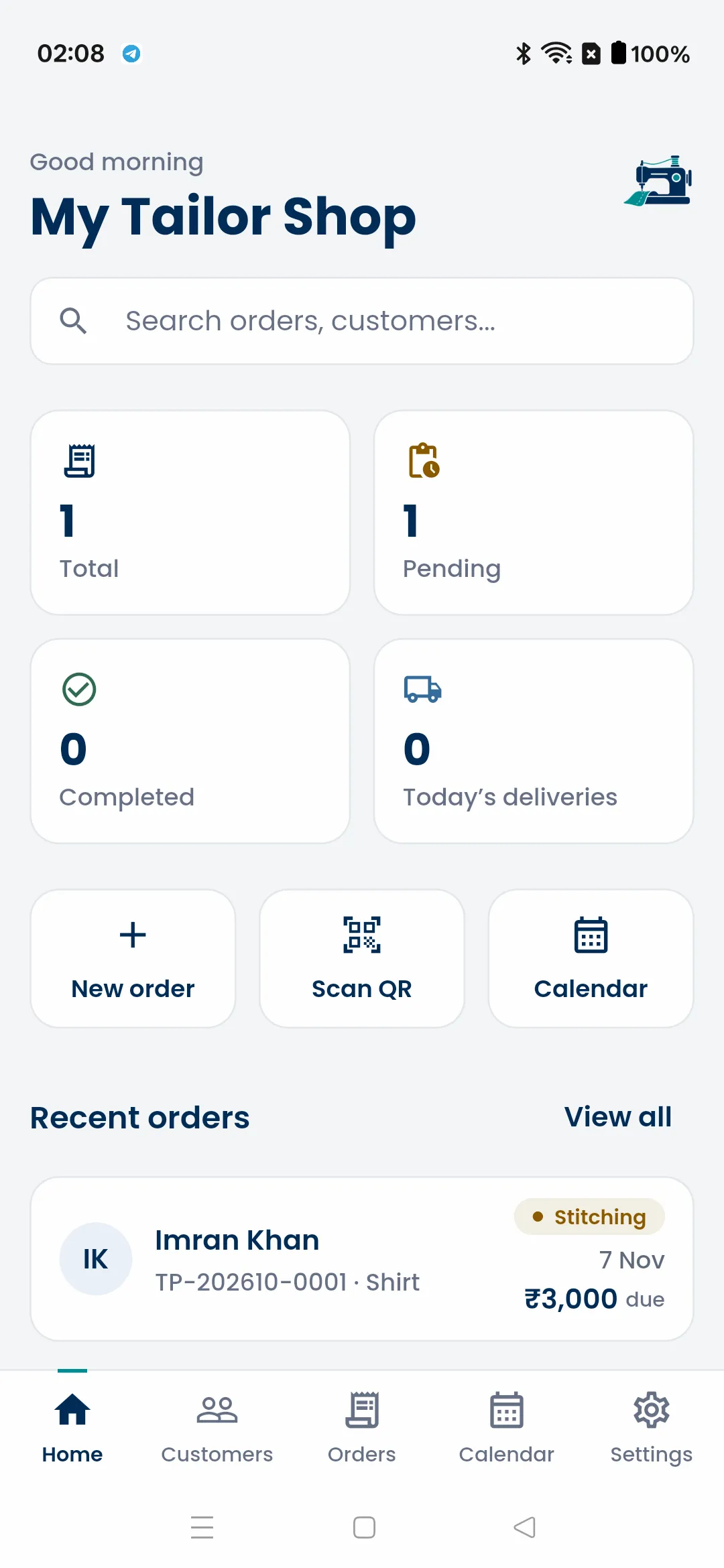
Naap in use.
An order in five short steps
Choose the customer, choose the garment, pick an existing measurement profile or skip measurement for an alteration, add style notes and fabric details, then set quantity, total, advance and delivery date.
A returning customer is served in well under a minute, because everything except the garment choice is already on file.
The measurement is the product
Every garment has its own set of fields — chest, shoulder, sleeve length, collar, cuff, waist, hip, inseam, kurta length, blouse length — and each customer can hold several named profiles per garment, such as Regular fit or Wedding suit.
Measurements are reused and edited rather than retyped, and the shop can add its own garment types with its own fields at any time.
- Shirt, trouser, kurta, suit, sherwani, blazer, blouse, salwar suit, lehenga, churidar and school uniform work
- Fewer remakes, because the measurement that was agreed is the measurement that reaches the workshop
Every order through the workshop
Each order moves through Received, Cutting, Stitching, Finishing, Ready for Pickup and Delivered, with one clear action to move it to the next stage. The order screen shows the stage, the customer, the garment, quantity, the delivery date, what has been paid and what is still due. Overdue orders stand out rather than hiding in a pile.
A compact receipt printer produces a workshop slip with the shop name, order number, dates, customer, garment, the full measurement list, style and fabric notes, totals and balance — and a square code that opens that exact order when scanned.
A month view marks the days that have deliveries, and selecting a day lists the orders due, so the shop can see a heavy Friday before it arrives.
A bill worth keeping
The invoice is a clean printable document with the shop's details, the work description, quantity, total, advance and balance, shareable to the customer on WhatsApp in one tap.
- A short shop PIN locks the app when the phone is put down
- Light and dark appearance are both first-class, on a bright counter or in a dim workshop
- The counter never waits for a signal: the records live on the phone